Tony Blair
was shadow Home Secretary – a rising star in the Labour Party, and the pundits’ favourite to succeed John Smith as its leader some day – when Roy McCloughry met him in his office in Whitehall on 14 September 1993.
It was the first of only two explicitly Christian interviews he gave before, in 1997, he became Prime Minister and his press secretary Alastair Campbell told the media: ‘We don’t do God.’
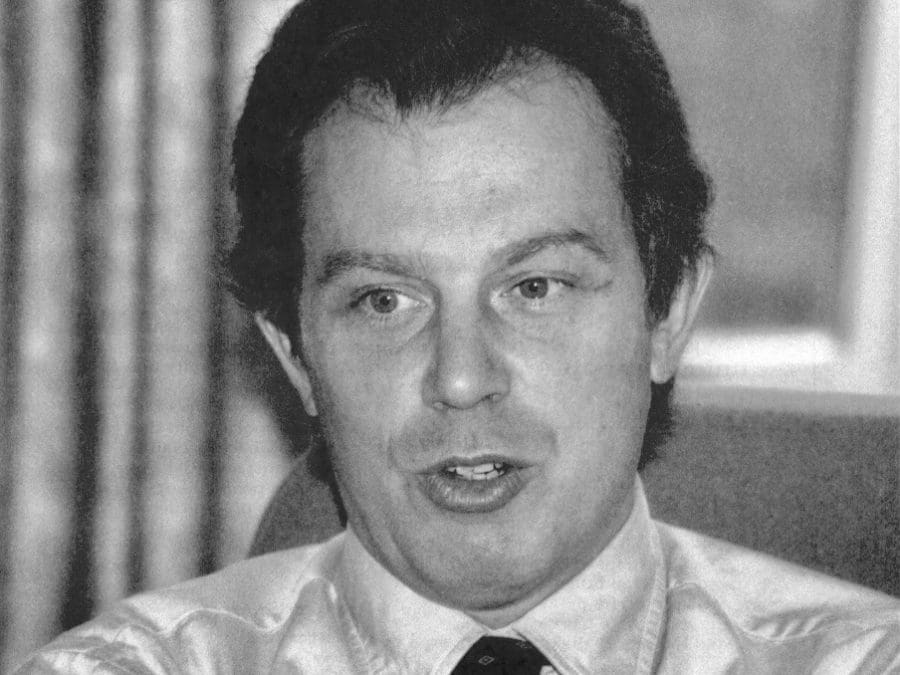
Photography: Clive Manning
You have recently identified yourself as a practising Christian. How did you come into Christianity?
I was brought up as a Christian, but I was not in any real sense a practising Christian until I went to Oxford. There was an Australian priest at the same college as me1Peter Thomson – see theguardian.com/the-rev-peter-thomson-obituary. who got me interested in religion again, and unusually I was confirmed at university.
What were you making a commitment to?
I think, to understanding how my beliefs about the world fitted into a spiritual context. In a sense it was a rediscovery of religion as something living, that was about the world around me rather than some sort of special one-to-one relationship with a remote being on high, which is very much the Christianity I had been brought up with. Suddenly I began to see its social relevance.
I suppose it coincided with a period of political development for me, and that rediscovery of Christianity as something that can be exciting, enjoyable and relevant was tremendously important to me. I began to make sense of the world.
Is your Christianity then a commitment to a philosophy rather than a personal thing?
No, it’s both. For a time I almost rebelled against the church and saw Christianity almost in humanist terms. Now, as I’ve got older, that has changed and I would see the two things combining together.
But is there a place, say, for personal prayer?
Yes, very much so.
Do you pray about political decisions or about the more personal side of things?
About both. I don’t think I really divide them up.
How does a socialism based on Christianity differ from one based on Marxist commitment?
My reinterpretation of the socialist message is that social responsibility is important to reinforce personal responsibility, not as a substitute for it
Marxism was an economic theory which purported to be almost deterministic in its view of human beings and their development. It came to represent (though I don’t think Marx ever really believed this) almost the belief that personal responsibility was swallowed up in social responsibility and that society would determine you as an individual.
I don’t think I ever quite believed that; to me, socialism has always been a set of values. That is very important, because what drove a lot of Christians away from socialism was the belief that somehow a person was less important than the state.
What are the central tenets of Christianity which, for you, demand a commitment to socialism?
The single most important thing – where my political and personal beliefs completely coincide – is the notion that people are members of the community, not simply individuals, isolated and alone. You are what you are in part because of others, and you cannot divorce the individual from the surrounding society. That idea of the individual and their place in society is to me the distinguishing philosophical feature of the Christian religion.
A sceptic might say that the word ‘community’ is a useful one for a politician – like an aerosol, you spray it into the air and there’s a sweet scent, but a bit of a mist as well. Isn’t it a little too vague a concept on which to base a Christian socialism?
I think the term requires a lot more definition, but it is at least a very useful counterpoint to the alternative, which is a very crude form of individualism. I think most ordinary people understand the concept of community, and understand its importance.
You have written that Christianity is judgemental.2In an essay for the Christian Socialist Movement, published that year, he had written: ‘Christianity is a very tough religion, it is judgmental. There is right and wrong, There is good and evil. It’s become fashionable to be uncomfortable with such language. But when we look at our world today and how much needs to be done, we should not hesitate to make such judgments. And then follow them with determined action.’ Are you moving away from the political liberalism of many middle-class Labour voters when you talk of Christian principles of right and wrong?
What I was trying to say was that the notion of the individual within a community is not a substitute for individual responsibility. In the end, you have to live your own life and take responsibility for the decisions you make.
When I say that Christianity is a very tough religion, I think there are certain imperatives of individual conduct that it is very, very strong on. It is not a religion that makes easy excuses for people. My reinterpretation of the socialist message is that social responsibility is important to reinforce personal responsibility, not as a substitute for it; and I think that is, in the end, what the Christian religion is about.
How do you square the pragmatism of current politics with such a conscience-based approach? Do you have a vision for the future of Britain?
Yes, I do. The task for my party is to rebuild Britain as a strong community, recognising that individual advancement is only possible within it.
But people use the word ‘pragmatic’ in two senses. One means that, for simple reasons of expediency, you don’t take a course which you believe to be right; but the other meaning is just that politics is the art of the possible, and you have to try to take people with you. You have to make sure that your policy does not create problems that are worse than the ones you were trying to cure. Now, that is pragmatism in a perfectly decent sense, and provided you keep that distinction in mind you don’t go far wrong.
There is a tendency for those in government not to tell the truth, and for those in opposition always to pretend that life could be made so much better so very easily
Politicians have been very bad at educating the public – and being honest with them – about some of the difficult decisions they face. Partly because of the nature of our politics, there is a tendency for those in government not to tell the truth, and for those in opposition always to pretend that life could be made so much better so very easily.
In fact, of course, it can’t. In the end, if politicians spend their time lying to the public, that just devalues politics; and if you devalue politics you’ve got a problem.
Doesn’t the public have a double standard about this? We want politicians to be honest, to come clean when they fail; but when they do, we don’t vote for them again. How do you handle that?
With difficulty, because you’re absolutely right, there are double standards.
I remember, some years ago on [BBC Radio 4’s] Any Questions, being asked a question and deciding I would be completely honest and say, ‘I haven’t the faintest idea what the answer is.’ Afterwards people said, ‘You can’t go round saying that, for God’s sake – they’ll think you’re not fit to run the country!’
Are there issues that arise from your Christian commitment on which you would have to defy the Whips?
Yes, there might be.
Such as?
I can’t think of an instance where there has been a whipped vote that I’ve had a great problem with.
I suppose there could be things on religious beliefs, or (for example) if we were to take measures that were very oppressive in terms of gay rights or something like that. Or if we were to vote for the restoration of capital punishment, I would take a principled objection to that.
But these are issues on the fringes of conscience. Are you saying that Labour Party policy perfectly suits your Christian convictions, and you find no conflict between the two?
No, I don’t. I suppose it would be untruthful to say that you agree with every aspect of your party’s policy on everything. The real question you would have to work out is whether, if you disagreed with something, it was so fundamental that you wanted to resign and so cease to be part of your own political movement in Parliament. Now, I’m not saying that is impossible, but I haven’t found that so far.
Church leaders have been heavily criticised for the way they have condemned or supported government policy.3Most notably, in 1985 the Church of England published a 400-page report titled ‘Faith in the City’, which blamed the then Conservative government’s economic and social policies for generating inner-city poverty, unemployment and social polarisation. One Cabinet minister famously dismissed it as ‘pure Marxist theology’, and Margaret Thatcher reportedly called it ‘wicked’. Do you think that is right?
It would be completely absurd if the church were silent on the big issues of the day.
Are there any limits?
The principles of the Labour Party don’t change, but the way that they’re applied of course has got to change
I don’t think there are. It’s important the church does not become an adjunct of any particular political party, but it would be bizarre if there were enormous problems in society and the church said, ‘Well, look, I’m afraid those aren’t for us, those are for the politicians. We’ll just talk to you in church every Sunday.’
Does the Conservative Party enshrine any strong Christian principles that you would like to see in the labour movement?
I think there were elements of the old Tory party in which notions of compassion and caring were fairly strong; but the problem with the changes the party has undergone is that they are rather frowned upon now. I think that’s a pity.
Can Labour ever take power again?
I think we have got to face up to social change. The great problem for Labour has been the failure to distinguish between a set of policy perspectives for one generation and a set of principles. The principles of the Labour Party don’t change, but the way that they’re applied of course has got to change.
What has to be left behind?
I don’t think the public really has any interest in the debate between public and private sector. I think it is much more interested in the standard of service. The Labour Party has to show how it will improve public services; simply to say we will renationalise them and that’s how you improve them does not really count with people any more.
We have to show how we reach out to those who live in their own homes as well as council tenants, and those who are working in offices and the service sector as well as those in manufacturing.
The danger comes when people regard that as leaving principle behind.
Dennis Skinner4Interviewed for High Profile in June 2009 has said that that approach wins the awards but loses the elections, and the left generally believes that the reason Labour has lost is because it has not been left-wing enough. You wouldn’t agree.
First of all, there is a fairly fundamental logical objection. It would be curious if the public were voting Tory if what they wanted was a more left-wing Labour Party.
The truth is that between 1979 and 1983 people like Dennis had control of the party organisation and policy, and when we went in on their manifesto in 1983 we almost went out of business.
Since then we have come back a long way, but not nearly far enough, and the reason for that is simple. For 30 years the Labour Party has been debating whether to accept social change and reapply its principles to a changed society, or to carry on in the belief that at some point the electorate will change back again. Well, it won’t.
Labour always used to talk of equality, rarely of freedom. Is your new emphasis on freedom a necessary accommodation of market capitalism, or is it a matter of principle?
Citizenship is about rights and responsibilities. … The problem for the left has traditionally been that it has underestimated the importance of personal responsibility
I think it’s entirely principled, because in the end that is what equality is about – the belief that if people were not more equal, then they were less free, they were less able to develop.
People on the left have made far too little of the fact that the nature of capitalism and market economies has changed dramatically this century as a result of the things our type of government has done. We are way, way behind in our analysis of capitalism as a market: people have thought that the choice is between a 19th-century capitalism and Marxism, and it’s not.
If freedom and equality go hand in glove, doesn’t that mean that a principled approach to freedom should mean higher taxes?
Well, it may do. I don’t say that the Labour Party should never raise taxes, but if we are to, or to spend more money, we have got to demonstrate to the public the purposes to which it is to be put. The problem for Labour in the past has been that people thought we would raise tax just for the sake of it.
Bill Clinton’s Democrats stopped talking about taxes and started talking about investing and growing. It may come to the same thing, but you start with the proposition that you are not going to tax people just because you are anti-wealth. That is an important part of repositioning Labour.
As shadow Home Secretary you have spoken a lot about law and order. You have brought a new sense to the Labour front bench of the relationship between social roots and personal responsibility. Is that the major theme for you in this debate?
It’s a major theme throughout my belief about what we have to do as a society and how Labour must change. A modern notion of citizenship is about rights and responsibilities: the problem for the right has been that they haven’t given people the opportunities and the rights, and the problem for the left has traditionally been that it has underestimated the importance of personal responsibility. I have tried to transcend that argument and say: ‘Look, in fact what you want is to combine the two.’
The sensible thing is to give young people a stake in our society: to give them respect, but demand respect in return. You don’t have to choose between old-style ideas.
The left had allowed itself to be put in a position where it basically never said: ‘This person has done something wrong and has got to go [to prison].’ I think that was an important shift for us to make.
To what extent is the rise of violence in our society due to a decline in personal morality?5Widespread public alarm that British society was becoming more violent was summed up in an ‘early day motion’, EDM 1439, set before the House of Commons in February that year.
In part these things are a natural development as societies become more prosperous, as all the means of communication – television and so on – develop.
Do you mean that violence is an expression of envy?
No, I don’t mean that. But as society reaches a level of prosperity – people own cars, videos, all the rest of it – young people have a lot more to spend. They go to pubs, they drink, they can travel around much more easily, and strong community values tend to break up. In some ways this problem is bound to appear at a certain level of development in society.
I think we have a more hard-headed understanding now that values have to be taught. You can see, as a father bringing up your children, [that] it is a constant problem
I think that notions of personal responsibility, of mutual obligation within society, are very, very important. What has happened is that as strong community and family ties have broken down, so all the normal mechanisms of reinforcement for personal responsibility and obligation have – not disintegrated, that’s too strong a word – certainly declined.
In a curious way, I think the Labour Party message is actually more relevant today in many ways than ever. We have to find ways to re-encapsulate proper community and family values. It’s all the more important because they’re not being reinforced by circumstances.
You can see this very clearly in the old mining villages in my constituency. There used to be very strong community ties, but they aren’t there any more. We need to rebuild them – otherwise you will find there is an element of society that grows up outside the mainstream, which has no stake in it, which sees how the rest of the world lives and is pretty antagonistic towards it.
But aren’t you arguing your case from the middle ground? You ignore the fact that things like community and family values are built on a fundamentally religious foundation which we have lost. The root cause of the fragmentation of our society and the rise in violence is the spread of secularism, isn’t that so?
Well, I think it is certainly to do with the absence of strong moral, philosophical and spiritual values. I think there are economic factors as well – if you’ve got very high levels of youth unemployment, and young people feel they just can’t make any headway. But yes, I do think that.
I don’t think it is just confined to the Christian religion. If you talk to some of the ethnic minority communities and that strong religious foundation is there, you find exactly the same self-discipline and values. There is no doubt at all about that.
There was a tendency at one time to think that people could live in a spiritual and moral vacuum, that you could simply stop teaching these types of values and people would make their own way towards their own accommodation with society. There were elements of Utopia in that.
I think we have a more hard-headed understanding now, that these values have to be taught and learnt. You can see, as a father bringing up your children, [that] it is a constant problem. They don’t just get to it by themselves.
What if this vacuum you speak of has been filled by some other, more powerful motivation? I would suggest that economics have replaced morality and that self-interest has become the prime motivation in Western culture. And so we are not dealing with a vacuum still waiting to be refilled with moral values, but with a society which has become displaced by economics. How would you respond to that?
I think that is a very interesting point. There is an element of truth in that.
What I would say, however, is that if you look at these very problems of crime and social disorder, you can see the limitations of that view, even in terms of self-interest. You could argue for change from my perspective on the basis of enlightened self-interest as well as on the basis of community values. If you start atomising society and just exist as individuals, economically and socially you end up with the problem we’ve got.
I’m in politics because political decisions are so important to the things I believe in. The actual business of politics, although I can do it, I don’t have a great deal of time for
But I agree with you.
How can you enlighten people who are governed by self-interest?
I think you must recognise the different society we live in: a much more individuated culture, in experience, lifestyle and all the rest of it. Where you try to advocate and persuade is to say: ‘Look, if you take that very narrow view of self-interest, we don’t end up with a better society and you don’t end up with greater individual prosperity.’
Has any country in history ever achieved this balance between freedom and shared prosperity?
I don’t think this is a state of perfection. You can see those countries that have been economically and socially successful. Even in Britain, where we have been successful is where those two things have coalesced together sensibly.
But Sweden, for instance, which for many years was pointed out as a kind of Nirvana, has now abandoned the welfare state and is seeking entry into the European Community.
Yes, but we get ourselves hooked up on the notion that that means the Swedish people no longer recognise the idea of shared prosperity. I don’t think that’s true. Any system after a time requires revolution and reform, and the welfare state is like any other institution.
That is what I keep saying in the Labour Party. Our job is not just to sit there and defend the status quo because that was the 1945 settlement or whatever. Our job is to put sensible reform in place, to improve it in accordance with the original values that gave rise to it.
People are very cynical about political leadership now: they say there are no great leaders in our generation. What do you think are the qualities of leadership that are needed in politics at the moment?
First of all, to tell people how the world really is. Secondly, I think, to be less tribal in our outlook as party politicians. And, as much as anything else, to give people some sense of hope that change is possible and that it’s not something to be frightened of.
Do you have those qualities?
Well, that’s for others to judge.
No, it’s not, because part of any leader’s security is the knowledge of his or her own strength.
Well, obviously I wouldn’t say things if I didn’t believe them. You will go through a testing time in politics where it will be found whether you’ve got those qualities or not.
In the end, I can walk away. I’m not obsessed with politics at all, and if I felt I really couldn’t make a difference I wouldn’t much bother. In fact, I don’t particularly enjoy the trappings of politics – indeed, I dislike a lot of them intensely. I’m in politics because political decisions are so important to the things I believe in. The actual business of politics, although I can do it, I don’t have a great deal of time for.
So we shall see.
A slightly longer version of this edit was originally published in the October 1993 issue of Third Way.
To make sure you hear of future interviews in this series, follow High Profiles on Facebook or Twitter or join our mailing list.
| ⇑1 | Peter Thomson – see theguardian.com/the-rev-peter-thomson-obituary. |
|---|---|
| ⇑2 | In an essay for the Christian Socialist Movement, published that year, he had written: ‘Christianity is a very tough religion, it is judgmental. There is right and wrong, There is good and evil. It’s become fashionable to be uncomfortable with such language. But when we look at our world today and how much needs to be done, we should not hesitate to make such judgments. And then follow them with determined action.’ |
| ⇑3 | Most notably, in 1985 the Church of England published a 400-page report titled ‘Faith in the City’, which blamed the then Conservative government’s economic and social policies for generating inner-city poverty, unemployment and social polarisation. One Cabinet minister famously dismissed it as ‘pure Marxist theology’, and Margaret Thatcher reportedly called it ‘wicked’. |
| ⇑4 | Interviewed for High Profile in June 2009 |
| ⇑5 | Widespread public alarm that British society was becoming more violent was summed up in an ‘early day motion’, EDM 1439, set before the House of Commons in February that year. |
To find out more about the agenda behind our interviews, read our manifesto. To access our archive of more than 260 interviews, see the full list.
Biography
Tony Blair was born in Edinburgh in 1953, and educated at Durham Choristers School and Fettes College. He went on to study law at St John’s College, Oxford.
He was called to the Bar in 1976, and served his pupillage with the Labour grandee Lord Irvine QC, in whose offices he met his fellow pupil and future wife, Cherie Booth.
He contested the safe Conservative seat of Beaconsfield in a by-election in 1982, and was elected MP for Sedgefield in County Durham a year later.
In 1984 he was appointed Opposition spokesperson on treasury and economic affairs; and in 1986, deputy spokesperson for trade and industry, with special responsibility for consumer affairs and city issues.
He was elected to the Shadow Cabinet in 1988, taking the portfolio first for energy for a year and then for employment until 1992, when he became shadow Home Secretary.
Up-to-date as at 1 October 1993