Ian Hislop
was appointed editor of the satirical magazine Private Eye in 1990 at the age of 26. Four years later, he made his first appearance on what was to become the longest-running show on British television, Have I Got News for You.
Martin Wroe quizzed him at the Eye’s office in Soho on 16 January 1995.
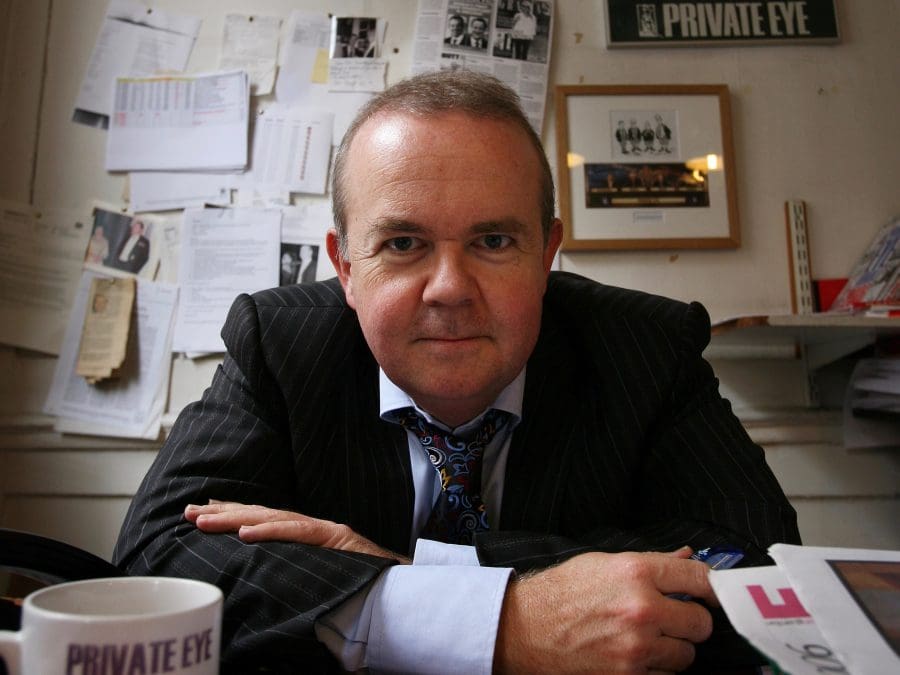
Photography: Toby Madden
Is satire just about throwing mud at the famous and powerful, or does it express a moral vision, that things should not be like this?
Satire is the bringing to ridicule of vice, folly and humbug. All the negatives imply a set of positives. Certainly in this country, you only go round saying, “That’s wrong, that’s corrupt” if you have some feeling that it should be better than that.
People say, “You satirists attack everything.” Well, we don’t, actually. That’s the whole point.
But Spitting Image is pretty indiscriminate, isn’t it? It seems to me your definition of satire would rule out much of the so-called ‘satire boom’ – I mean, was there ever any moral vision behind Monty Python?
A lot of what has been called satire isn’t. Monty Python was surreal comedy. Spitting Image just makes jokes about whoever is in the news.
Whereas the aim of satire is to change perceptions of specific individuals or situations?
Or crystallise them. You can’t often completely change them. People say: ‘You never brought Mrs Thatcher down – you always presented her as very strong, kicking her Cabinet around.’ Well, she was very strong, and she did kick the Cabinet around.
Satire can’t just make stuff up. No one buys it. You can exaggerate and distort reality, but if you’re not on the nail, you’re nowhere.
Is there any evidence that satire leads to change?
There’s no direct evidence that it ever achieves anything. Jonathan Swift1The author most notably of Gulliver’s Travels (1726) managed to get one tax revoked in Ireland – ‘Wood’s Halfpence’, I think. That was it. And he was the best.
Nearly all satirists are conservative… There is a long tradition of suspicion of the new and an attempt to cling on to the wreckage of whatever you can. It’s not a very optimistic position
Do you think that satire can sometimes be counter-productive – that it can help to create a cynical society in which no one has any respect for anyone?
I don’t – I think it would make me feel guilty if I did. But respect has got to be earned. So, if you have got a generation of politicians who don’t deserve it, you shouldn’t give it to them.
Has anyone ever written to you and said: ‘I read that piece about me in your magazine, and I’m completely wrong. I do apologise’?
They haven’t, no. But I’m convinced the drip of it eventually makes a difference.
Like, we put a cheap joke on the cover of a little girl in hospital and Mrs Thatcher saying, ‘What will you do if you grow up?’ You can either write 2,000 words in the Guardian about the failure of the health service or you can make a joke about it, and quite often the joke gets the point across.
Do you ever think, ‘This is a sub-Christian activity’?
Or a non-Christian activity. Sometimes I do, yes. Speaking ill of your neighbour on a regular basis is not wholly in tune with the tenets of Christianity. But then I’m not wholly in tune with them, either.
But I think there’s a good case to be made for the role of the satirist. Some of the great ones have been Christians, and a lot of people have felt it’s a good weapon. What did [Alexander] Pope say? ‘O sacred weapon! left for Truth’s defence.’ That was his definition.
Can satire ever be an expression of affection?
I think a lot of it comes from knowledge. The reason everyone [at Private Eye] enjoys writing the Rocky Horror Alternative Service Book, when we sit around devising the Prayer of the Humble Access Card, is because we know those services back-to-front from childhood, and there is the sort of attachment to them which doesn’t ever go.
Isn’t there a kind of fogeyism about it as well?
Oh, there’s a definite fogeyism, yes – and a definite resistance to change. That’s inherent in satire, really. The new comes along and you have a go at it. It’s very odd, because the rest of the time you’re having a go at the old and saying how useless it is. I suppose one needs to be convinced, really. Nearly all satirists are conservative…
They’re not anarchists?
No, not at all. They’re usually chippy, middle-class people. He said confidently.
There is a long tradition of suspicion of the new and an attempt to cling on to the wreckage of whatever you can. I suppose it’s a belief that the new might turn out to be absolutely ghastly. It’s not a very optimistic position. Juvenal said, ‘This country is going to the dogs’ in AD160 – and, in fact, he was saying it in one of the most peaceful and prosperous periods the Roman Empire ever had.
We’ve created a [political] culture in which there is no real responsibility. Whatever mistakes you make, the voters let you off; no amount of error is bad enough to actually merit you leaving
All countries have always been going to the dogs. At the moment, this country has a better standard of living than it has ever had at any period in its history. There is no material reason for complaint, except for a specific group of untouchable, unemployed, homeless or whatever, who have nothing – but their nothing is still a great deal more agreeable and comfortable than the Dickensian nothing, or the Thirties. Yet the sense of malaise has never been stronger. You could probably give everyone in the country a pay rise and they’d still say, ‘Nothing good’s coming’
And yet, compared with the way that most people live most of the time in the world today…
Being white and living in Britain alone is enough cause for rejoicing. It is an amazing privilege, as we devour most of the world’s resources and say, ‘Oh, we’re really miserable.’
In the one-party government we’ve had for the past 16 years, have we bred a new strain of sinner who is impervious to criticism or ridicule, who apparently has no sense of shame?
I think we’ve created a culture in which there is no real responsibility. (One sounds a bit like Michael Portillo.) It’s very peculiar – the idea that because you’re always in power and whatever mistakes you make the voters let you off, no amount of error is bad enough to actually merit you leaving.
I think that’s what happens with long administrations – they get morally corrupt as well as politically corrupt. They’re no longer interested in anything except survival.
And that is happening with the current government?
Yes, I think they’re a burnt-out fag-end of an idea which when Mrs Thatcher was driving it – however much you hated it – had a certain force. You didn’t get the feeling she was in it for the money, whatever she’s doing now.
And no one seems to be contrite any more. No one ever says, ‘I’m sorry, I made a mistake.’
No, they just completely reverse policy and pretend it hasn’t happened. There’s an awful deception involved.
Is it ever possible to penetrate that veneer of self-justification? Even when politicians have clearly made major errors, even under the most intense grilling they are able to evade the point. Sometimes the media seems almost powerless.
Well, the trouble is it just doesn’t have long enough. You can, more or less, brazen anything out in seven minutes. If someone has an hour with you, you may fall apart – but no one ever does have an hour.
Jon Snow2The veteran presenter of Channel 4 News, interviewed for High Profiles in November 2004 said to us, ‘How do you really put the boot in? I only get access to the Prime Minister maybe once a year.’ He’ll just go on David Frost, who’ll suck up to him. They choose their outlets, and then when you do get at them you get them for such a short period of time that you can’t do anything.
So, your approach is not to interrogate them but to make fun of them?
There are a few good guys around [in politics] – people who are not in it for the money, because they already had it. And old public-service lefties – I disagree with many of their views, but…
Yes, to make them appear more strongly in the way you perceive them.
The ‘Secret Diary of John Major’, which is the most popular thing we’ve done for years, is just one joke essentially. We’ve elected Adrian Mole and he’s getting more petulant and unpleasant as the story goes on. Not only is he hopeless and incompetent, he’s actually getting very vain, too. Rather puffy and I’ve-been-here-for-four-years-and-I’ve-survived-and-I’ve-been-right – a ghastly assurance. He seems to be unflappable – nought per cent in the latest poll and he doesn’t mind.
And there have been periods, like last autumn,3On 20 October 1994, a minister in the Northern Ireland Office, Tim Smith, had been obliged to resign after he admitted accepting a total of £18,000 for asking Parliamentary questions on behalf of the Egyptian businessman Mohamed Al-Fayed. Five days later, the minister for regulation and corporate affairs, Neil Hamilton, resigned in the face of similar allegations. In fact, these were only two of a series of cases of ‘sleaze’ that plagued John Major’s government – see wikipedia.org/Back_to_Basics_(campaign). when everything seems to be going wrong, and you think: At any other time in recent history the Government would have collapsed, but this one will just carry on.
That number of scandals would have just finished any government. But if you don’t have shame, you don’t go. Not one of those people involved in that wave of sleaze has offered any suggestion that they were in the wrong.
I think the media is certainly to blame for encouraging these people to take up a role afterwards as a celebrity. David Mellor is the worst case in point.4The then Secretary of State for National Heritage had resigned in disgrace in September 1992. The tabloid press had exposed his extramarital affair with an actress two months earlier and had followed up with a stream of allegations about his business and social connections. Peter Preston5Then editor of the Guardian, interviewed for High Profiles in December 1994 said he’s a brilliant journalist and he could have any job on the Guardian. I mean, what happened to the old Manchester Guardian, that repository of supposed hard-core values?
And he isn’t brilliant – he’s just a hopeless, third-rate hack who knows bugger-all about music or football, but he’s allowed to just sound off. He was on the Today programme one morning commenting on political sleaze. There is only one response: Get off! You are not in a position to talk about this.
He dragged his wife on the programme in the middle of the Lady Cobham thing to say, ‘Oh yes, I’m standing behind David.’6Viscountess Cobham had been a special adviser to Mellor at the Department of National Heritage. In 1994, they announced that they had developed a close relationship and intended to divorce their existing spouses – which they did the following year.
Are there any good, decent, honest, admirable, trustworthy, kind, sincere people left in public life?
There are, actually. There are a few good guys around and you occasionally meet them, which is very embarrassing.
People like Richard Shepherd,7See wikipedia.org. who I’m always very impressed by. He’s that sort of backbench Tory rebel – he did a lot of stuff on freedom of information Bills. There are old sorts of Tories – Richard Body8See wikipedia.org. I used to like.
People who are in it as a vocation?
People who were not in it for the money, because they already had it.
And there’s a good bunch of old public-service lefties around – I disagree with large amounts of their views, but –
But apart from politicians?
There are many more in campaigning groups. The other odd thing about the way politics has gone is that there seem to be more people doing important things outside Parliament now, in pressure groups and lobby groups. People are so bored with Westminster.
Are there good people you wouldn’t attack? Mother Teresa, for example?
I often think I would have been one of the smart-arsed people wandering by the cross, trying to think of something amusing to say. ‘If you’re the Son of God, why don’t you save yourself?’ – very funny
Yes, not because she’s so holy there would be nothing to say, but I just would not choose her.
I watched that Channel 4 let’s-get-Mother-Teresa programme in amazement.9The documentary Hell’s Angel, screened in November 1994, was presented by Christopher Hitchens and produced by Tariq Ali. Hitchens had originally wanted to title it ‘Sacred Cow’. I don’t like her stance on lots of issues, but to suggest that this woman became a nun at the age of 18 in order to have a soft life going around on aeroplanes and meeting famous people was probably a bit wide of the mark, really.
Is it ever wrong to attack someone who’s already down? Can somebody be over-satirised?
Richard Ingrams10Hislop’s predecessor as editor of Private Eye, interviewed for High Profiles in February 1999 always used to say, ‘Suffered enough, suffered enough!’ That was his bottom line. I didn’t always agree with where that line was – I thought perhaps another kicking was in order, just one more. But I think there is a point where you’re just shooting fish in a barrel.
If Jesus were alive today, would the Eye go for him, or just the disciples?
I often think I would have been one of the smart-arsed people wandering by the cross, trying to think of something amusing to say. ‘If you’re the Son of God, why don’t you save yourself?’ – that’s very funny. When I hate myself most, I imagine that’s what I might have been doing.
What do you make of a society in which it is more or less unacceptable to say something scurrilous about Mohammed, or even Martin Luther King, but Jesus Christ is fair game?
I think it’s wet, cowardly, pathetic and just a symbol of spinelessness, really.
I’m perfectly happy to attack the church or the follies of vicars or the absurdities of doctrine; but merely to attack the person of Christ… I don’t do it. On Have I Got News for You a while ago, we were looking at a famous mosaic of Christ Pantocrator, and someone said he looked as if he was sucking on a lemon. And he did, and it was quite funny and quite innocuous, but I still winced. The mockers in the Gospels still worry me.
Why is the church such a constant and easy target?
Oh, because it’s a left-over taboo from the days when it had power and influence. Satirical targets change very slowly, particularly amongst the less talented, so it’s like: We’re really, really going to lay into the C of E, right? Well, why? What possible source of power do you think the C of E has now? None. The Archbishop makes a comment and it gets on the front page of the [Daily] Telegraph, because that’s what the Telegraph does.
It’s such a confused and easy target, really, because it’s in such a mess itself.
The Eye’s attacks are always very specific, about changes in the liturgy reflecting what seems to be an inability to take any particular line on any subject. That’s what the Rocky Horror is always doing, saying you don’t know what you think on this, you don’t know what you think on this.
There was a very funny piece in one of the papers about Ian McKellen ripping pages out of the Bible, which just said: ‘Why don’t you rip up the Koran live on stage, Mr McKellen? That would actually be brave.’ You rip up the Bible and no one cares.
I think it’s a tribute to the C of E myself, that you can say more or less what you like and no one goes and knifes you.
[Britain is] a place where you can say, ‘Ha ha ha, the Bishop’s a bit of a wanker’ and be taken as a wit. In Egypt, you say, ‘I’m not sure the mullah’s got it entirely right’ and you get put into a shallow grave
But that’s probably also a source of its weakness, isn’t it? It’s always good for religion –
To be a bit scary? But it’s also what a lot of people like about the C of E – it’s been Torquemada-free. You can be an Anglican without wanting to hurt badly people who aren’t – which never seemed to me a bad thing.
So, it’s good that George Carey11Then Archbishop of Canterbury, interviewed for High Profiles in October 1997 doesn’t have that moral, or even legal, authority?
And it’s not coincidental, either. We have a tradition of satirical writing in this country of about 600, 700 years, from Chaucer and his contemporaries onwards, and that is part of what has built this country into what it is.
That does sound pompous. But it is part of what makes this a place where you can get up and say, ‘Ha ha ha, the Bishop’s a bit of a wanker’ and be taken as a wit. In Egypt, you say, ‘Well, I’m not sure the mullah’s got it entirely right’ and you get put into a shallow grave.
That is the difference between our cultures and I don’t think it’s something to be embarrassed about.
Is it the fault of the church that people no longer believe the story it tells? Is that because other things have made the story less believable, or because the church lacks credibility?
I suppose some of it must be blameable on outside forces, but a church that doesn’t believe it strongly itself is never going to make anyone else believe it.
Although some churches are doing a good job.
Yes. I saw some billboards up on the way here – ‘Christians Make Better Lovers’ – which seemed to me quite funny. Certainly made you think twice.
We’re told that nowadays everything is falling apart – the Royal Family, government, law and order. Is the church just a victim along with the rest?
I think the church gets it in the neck because it’s blamed for all the rest. The one thing everyone says when they can’t think of anything else is, ‘Why doesn’t the church give a lead?’ And as soon as it does, there’s an editorial in the Sun saying: ‘Get yer nose out of it, Mr Straight-Laced Parson!’ So, the church is in a bit of a no-win situation.
It must be awful being a vicar – I can’t think of a worse job, I really can’t. You get it from all sides.
Whereas nobody expects Private Eye to take a lead, because it isn’t your job.
We’re not social reformers or propounders of new philosophies. There aren’t blueprints for change coming out of the Eye. You’re trying to point out what doesn’t work, so that people won’t do it again.
When you were 14 or so, you were converted –
I got saved.
Sometimes, I sit in church and think: ‘This is complete bollocks, all of it, and always has been,’ and then a month later I’d sit there thinking: ‘This is all there is’
Religious revival, speaking in tongues –
Pretending to speak in tongues, largely.
What do you make of that experience now?
I find certain aspects of it very funny and a lot of it absolutely cringeworthy, and I have said that I’m more interested in the King James Bible now than in the arrival of the kingdom.
I have got to a point where I’m very happy about religion now – it’s God that’s my problem.
What do you mean, you’re happy with religion?
I suppose I can find more in the liturgy and the trappings and the edifice of it than in a straightforward ‘I have a personal relationship with Jesus.’
You don’t think it’s possible to be friends with God?
I remember saying it and it not being true at the time. You know, ‘I’ve really discovered him as a person.’ I don’t think I had really, and I’m not sure he is a person. I hope he’s rather more than that.
Well, he’s at least three persons, apparently.
Well, yes. I suppose I’m hoping for something grander and larger. I’m looking for awe and fear rather than mateyness.
There is a premillennial tension in society, with a lot of people asking, ‘Is this really it? Surely there’s more to life than this?’ Can you see some less embarrassing version of a revival taking place?
Yes, that may be the way it goes.
There’s also a part of me feels – as you’ve probably gathered, I’m all over the place on this subject – that being embarrassed is actually terribly good for you. I have a vision of the early church being quite staggeringly embarrassing for everybody – which I’m sure was part of their point, really. There is a sort of nakedness about it that worries the hell out of everybody, because it comes in straight.
A lot of people get into that church groove when they get older, have children. Are you a churchy type yourself?
Oh, yes. I always have been. I am the sort of Christian that evangelicals get very upset about. I go at Christmas or maybe at Easter, and a few baptisms as well. My children are baptised.
Sometimes, I sit in church and think: ‘This is complete bollocks, all of it, and always has been,’ and then a month later I’d sit there thinking: ‘This is all there is.’
Is that to do with changes of mood, or do you feel you’re on a journey, and maybe there’ll be a point at which you think more often than not, ‘This is it’?
I’ve been through periods of belief – not only evangelical but more traditional – and after the death of my mother, in particular, I found myself very moved by the fact she’d found comfort in religion – which was immediately followed by a period of immense irritation because it didn’t offer solace to me.
I had a holiday in Italy, just walking round the sort of church architecture that usually I find very inspirational – the fact that this faith produced this is often nearly good enough for me, really – and then just thinking, ‘Well, so what?’
You are on record as saying, ‘I am not a Christian,’ but now you’re saying you’re a sort of one.
[The broadcaster] Sarah Kennedy said to me on the radio: ‘You’re not a Christian,’ and I laughed and said, ‘No.’ But I felt, ‘Oh dear, there’s a cock crowing,’12See Matthew 26:33f. and the reason I didn’t admit it was because it’s really uncool.
But, well, I’m not sure I am, really. I end up just saying I believe in belief and I keep wanting. I believe in other people’s belief, in being genuine. I believe in the possibility of belief.
A slightly longer version of this edit was originally published in the March 1995 issue of Third Way, under the title ‘Is Nothing Sacred?’.
To make sure you hear of future interviews in this series, follow High Profiles on Facebook or Twitter or join our mailing list.
| ⇑1 | The author most notably of Gulliver’s Travels (1726) |
|---|---|
| ⇑2 | The veteran presenter of Channel 4 News, interviewed for High Profiles in November 2004 |
| ⇑3 | On 20 October 1994, a minister in the Northern Ireland Office, Tim Smith, had been obliged to resign after he admitted accepting a total of £18,000 for asking Parliamentary questions on behalf of the Egyptian businessman Mohamed Al-Fayed. Five days later, the minister for regulation and corporate affairs, Neil Hamilton, resigned in the face of similar allegations. In fact, these were only two of a series of cases of ‘sleaze’ that plagued John Major’s government – see wikipedia.org/Back_to_Basics_(campaign). |
| ⇑4 | The then Secretary of State for National Heritage had resigned in disgrace in September 1992. The tabloid press had exposed his extramarital affair with an actress two months earlier and had followed up with a stream of allegations about his business and social connections. |
| ⇑5 | Then editor of the Guardian, interviewed for High Profiles in December 1994 |
| ⇑6 | Viscountess Cobham had been a special adviser to Mellor at the Department of National Heritage. In 1994, they announced that they had developed a close relationship and intended to divorce their existing spouses – which they did the following year. |
| ⇑7 | See wikipedia.org. |
| ⇑8 | See wikipedia.org. |
| ⇑9 | The documentary Hell’s Angel, screened in November 1994, was presented by Christopher Hitchens and produced by Tariq Ali. Hitchens had originally wanted to title it ‘Sacred Cow’. |
| ⇑10 | Hislop’s predecessor as editor of Private Eye, interviewed for High Profiles in February 1999 |
| ⇑11 | Then Archbishop of Canterbury, interviewed for High Profiles in October 1997 |
| ⇑12 | See Matthew 26:33f. |
To find out more about the agenda behind our interviews, read our manifesto. To access our archive of more than 260 interviews, see the full list.
Biography
Ian Hislop was born in 1960 and educated at Ardingly College and Magdalen College, Oxford, where he studied English and edited the humorous magazine Passing Wind.
He joined Private Eye in 1981, becoming deputy editor in 1985 and editor the following year. In 1991, the year the Eye was proclaimed ‘magazine of the year’ by BBC2’s What the Papers Say, he was named ‘the editors’ editor’ in the British Society of Magazine Editors’ annual awards.
He was a columnist for the Listener from 1985 to 1989, and continues to contribute articles and reviews to newspapers and magazines. His writing for television includes sketches for ITV’s Spitting Image (1984–9) and BBC2’s Harry Enfield’s Television Programme (1990–2): and, with his frequent collaborator Nick Newman, plays for Trevor Eve (‘The Stone Age’), Maureen Lipman (‘Briefcase Encounter’) and Dawn French (‘The Case of the Missing’, ‘He Died a Death’ and ‘Mangez Merveillac’).
Since 1990, with Angus Deayton and Paul Merton, he has taken part in eight series of BBC2’s multi-award-winning quiz show Have I Got News for You. His satirical soap opera Gush, co-written with Nick Newman, was broadcast in 1994 on BBC Radio 4.
He was married in 1988, and has two children.
Up-to-date as at 1 January 1995