Ann Widdecombe
had just entered the Shadow Cabinet, with responsibility for health (and a reputation for pugnacity), when Roy McCloughry met her in her office in the Palace of Westminster on 20 July 1998.
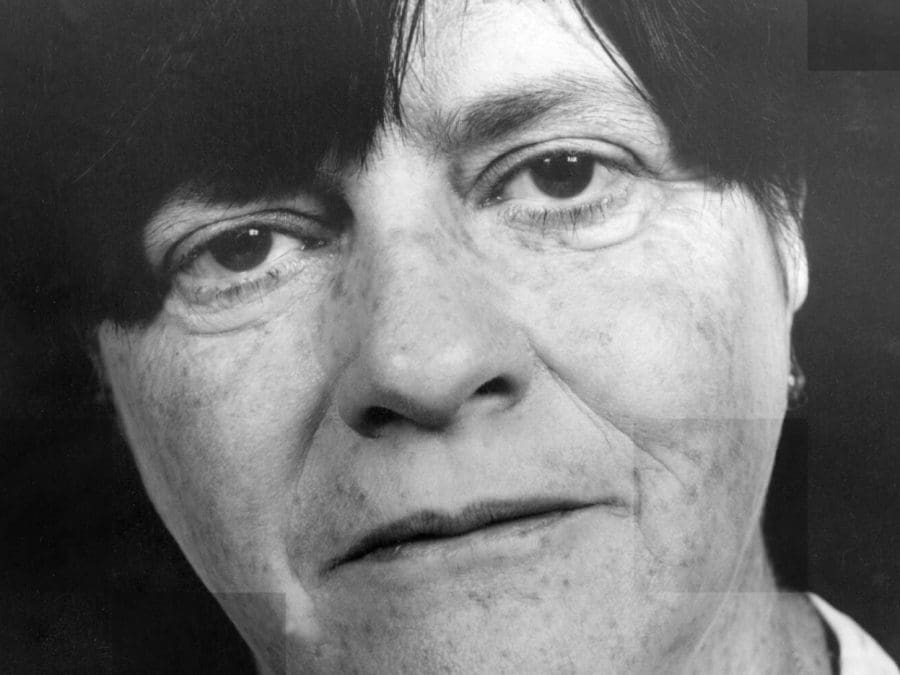
Photography: Simon James / National Portrait Gallery
What kind of values and principles were instilled in you as a girl? Did you have a Christian upbringing?
It was very strongly Christian. My family were practising Anglicans, I was sent to a Roman Catholic school, Sunday School was a normal part of my upbringing, as was church, faithfully every week.
What did Christianity mean to you then?
I think that when one is young one says what people want to hear. I actually would have appreciated being encouraged to question more, because I did most of my questioning consequently as an adult and had a period of agnosticism much later on in life – which I don’t think I would have had had I not felt the pressure which we all felt in those days to say, yes, we believed every last jot and tittle.
What brought you back to faith?
Nothing in particular. Becoming agnostic was a gradual erosion of belief; coming back was a gradual erosion of unbelief. There was no great flashing light on either occasion.
What does it mean to you now to be a Christian?
I don’t think you are leading a Christian life if you just accept, for instance, the principles of the Sermon on the Mount but don’t do any more than that. A lot of people say, ‘Oh, I’m a Christian by inclination, or by philosophy’ or some such nonsense. It’s not possible. You are either a Christian or you are not, and being a Christian actually means not passive but active belief in Christ as Redeemer.
Your ‘conversion’ to Rome was a huge intellectual and spiritual leap…
It was not, actually. I felt I was crossing a bridge rather than jumping some great abyss. Of course, if you cross a bridge your back is to one side, so there is a positive act of rejection involved.
It’s very difficult to be thoughtful when you’re dealing with the modern press, because they don’t like it. … On the other hand, I think that if you tell the truth, you will prevail
I think my single biggest error was joining the Church of England when I came back from agnosticism. I had very much admired Rome from afar, so to speak, but I still had some doctrinal reservations and wasn’t really ready at that point to go through the necessary business of resolving them. And so, almost out of familiarity, I went back to the Anglican Church, despite the fact that by then I despised it.
When I say I despised it, I do not mean the thousands of very conscientious clergy who teach the faith. What I am talking about was the eternal tendency of the hierarchy all the time to sacrifice faith to fashion, creed to compromise. I think the debate on the ordination of women typified that. It was not about theology, it wasn’t about ‘Is it possible for a woman to be part of the apostolic succession?’, it wasn’t about headship. The leader of the Church of England actually said, ‘If we don’t do this, we shan’t be acceptable to the secular world.’
Now, on the other hand you get Veritatis Splendor,1An encyclical by Pope John Paul II, published in August 1993, that addressed fundamental questions of the Catholic Church’s moral teaching and emphasised that moral truth is knowable and universal across cultures where the Pope says, ‘You can’t judge good by whether it’s popular. It’s either right or it’s wrong.’
Some people might say that Anglicanism is about what they would see as necessary compromise –
Ha! Hang on, I’m not taking that. At the time that I was still in the C of E, you had a senior bishop – number four in the batting order – actually questioning articles of creed. He questioned the Virgin Birth, the Resurrection, the existence of hell. A Catholic bishop would have had to resign. The [then] Bishop of Durham just carried on.2She is referring to Dr David Jenkins, who was interviewed for High Profiles by Roy McCloughry in May 1994 (when he strongly rebutted the notion that he ‘questioned the Resurrection’).
So, the openness to questioning that you wish you’d enjoyed in your youth is not something our leaders can share?
I don’t think there is anything wrong with a leader of the Christian church saying, ‘I’ve had doubts,’ or ‘I find this difficult.’ That wasn’t what the bishop was doing. He was actually saying it is not necessary for Christians to believe certain things.
Supposing I stood up as a Conservative and said, ‘Actually, it’s not really necessary to believe in private enterprise.’ Wouldn’t last two minutes. And nor should he have done.
What would your message be to the leadership of the Anglican communion?
I would simply say, ‘Put faith first. Stop shilly-shallying around, trying to appeal to the modern world. Your business is to lead the world, not follow it.’
Some people say that today we have government by focus groups, and your own party leadership is concentrating for the next year at least on ‘listening to Britain’. Is it difficult today to stick your neck out?
Absolutely. I’m afraid we have a very trivial press who are not interested in solid worth or in the major questions that have to be answered. If you identify a problem, the first thing a journalist will say to you is, ‘What are you calling for, then?’ You say, ‘Hang on! I’m not calling for anything at this moment. I’m pointing out that there is a problem.’
Likewise, if you have a policy that causes a lot of concern and you stick to it, the press will say you haven’t listened. If you examine it and you think, ‘Yes, actually, we could amend it,’ they won’t say, ‘They’ve listened and changed their minds’: you will have committed ‘an embarrassing U-turn’.
I’m amazed at the things I believe. I apparently believe in chaining women up in childbirth. I get a lot of letters from homosexuals who seriously think that I think they’re inferior beings – which I do not
It’s very difficult to be responsible and thoughtful and measured when you’re dealing with the modern press, because they don’t like it. That is one problem. The second is totally unreasonable expectations. Britain has undergone a sea change since the War and the attitude now is that every last expectation must be fulfilled and that every problem has a quick fix. You see this particularly in private morality. Unwanted pregnancy? Have an abortion. Problems in the marriage? Get a divorce. All the time, the quick fix. And it’s the duty of the state to provide it.
So, there are a lot of problems to leading in this country. On the other hand, I think that if you tell the truth, you will prevail. Recently, I have been saying that you cannot expect that a health service that is funded from general taxation can meet unlimited demand – as and when that demand falls, in whatever locality, on the front doorstep by the middle of Wednesday afternoon. Can’t be done. A few years ago, that would have caused a howl. Recently, there has been a greater acceptance of that proposition. So I think you tell the truth and hang on.
Some people see our growing disrespect for authority as a healthy thing – a mark of freedom. You don’t.
No. I think there’s an enormous difference between subservience and just basic respect. When you go to see the doctor, if he says, ‘This is your problem, this is the science of it. Intervention will solve it only to a limited extent,’ people accept that.
The same respect is not accorded to politicians. I’m not talking about a lot of kowtowing, just listening to what the politician is saying, that there is not some magic-wand answer.
Arguably, the Suez crisis [in 1956] and then the Profumo affair [in the early Sixties] transformed the relationship between the media and politics. Is it possible to undo that?
I think it is, but I think you do so not by seeking to go backwards but by going on. You say, ‘Right, we’ve had this period when the media find everything deliberately wrong and seek not to inform but just to titillate and horrify. Now, perhaps, we can have a few more grown-up discussions.’
Do you think your views get distorted?
Oh yes, all the time. I’m amazed at the things I believe. I apparently believe in chaining women up in childbirth. I now have a ‘personal confessor’ who comes round every five minutes as far as the rest of the world is concerned. I get a lot of letters from homosexuals who seriously think that I believe it should all be made illegal and that I think they’re some sort of inferior beings, which I do not. I get similar letters from single parents.
Recently, I said very carefully on a programme that I thought that just because you tolerated something you couldn’t accord it equal validity with what I described as the preferred social model, which was the traditional family. That was translated by the Press Association as, I believed that gays and single parents are inferior. That was reported in the press with inverted commas round the ‘are inferior’, as if I had actually said it.
Believe it or not, there is no recourse against that either in law or before the Press Complaints Commission. That is regarded as a fair way of reporting. The fact that I never used the word ‘inferior’ nor implied it in the sense in which it was used all over the press – well, there you go.
Why do you think people misrepresent your views?
Young people are looking for two things: the supernatural and a set of rules. Why is the church falling down? Because it’s afraid on both scores
There are two reasons. One is that the press very much like drama – only drama sells newspapers – and so they will always seek to dramatise what you are saying.
The second thing is that the press are downright careless. Whereas editors used to hold journalists to account if they reported inaccurately, now they do not. I’ll give you a prize example. I worked for David Hunt when he was Secretary of State for Employment. A newspaper was getting together tributes to him on some occasion and they rang me to ask if I had any anecdotes. I said that once when I was ill he had sent me a huge bunch of flowers. (Most secretaries of state wouldn’t even have noticed.)
I then read in the paper that I had been taken ill and that I came round in hospital and saw a bunch of flowers on my bedside, and when I asked who it was from, it was from the Secretary of State. Just rubbish, just rubbish. I wasn’t in hospital, I didn’t come round: I went to the door and received them in the usual way. It doesn’t matter fourpence three farthings, except that it’s a clear indication that the press do not care about accuracy.
You alluded to the media’s obsession with your ‘personal confessor’. I suppose that confession is quite alien to our culture. People don’t see the need for it.
Oh, they do – but they do it in very different ways. Just look at Oprah Winfrey, look at all those shows which consist of people revealing for audiences of millions things that you or I wouldn’t tell our close friends. Look at the problem pages of any magazine. Over the last 30 years we’ve seen a complete collapse of what I call ordinary, decent reticence – people are rushing to put absolutely everything into the public domain.
But why should a moral person need a confessor?
Christians believe that they should confess their sins. Catholics believe, ‘Whosoever sins, ye shall forgive. They shall be forgiven.’3See John 20:19–23. That is very clear authority given by Christ to the apostles and their successors.
Do you have any political or spiritual heroes?
Winston Churchill probably influenced our entire generation, particularly of Conservative politicians. I hate Oliver Cromwell. I have no inclinations towards vandalism, but every time I pass his statue [outside the Palace of Westminster]…
The present Pope and the present Cardinal4Respectively, John Paul II and Basil Hume I find remarkably holy men. I mean, when you are with them, you feel a tangible link with the early church. The only other person I’ve felt that way with was Mother Teresa. They are tremendously influential. If one looks back, then [John Henry] Newman,5See wikipedia.org. certainly, and St Peter himself. I think he was a wonderful character – always rushing into things. Half the time he got it wrong, but he was fantastic.
Do you think there is any tension between the quest for holiness and the quest for relevance?
No, I don’t see why there should be. Very few people would say that Christ was not a man of his time – and, indeed, if you look at the way he behaved he was the scandal of all Jerusalem: feasting with publicans and sinners, a glutton and winebibber, breaking the Sabbath… Look at St Paul, the way he picked things up, the Unknown God and this sort of thing.
We have built a cult of tolerance based on condemning neither the sinner nor the sin, which I think is wholly wrong. And we’ve also lost the virtue of restraint
So, no, I don’t think you have to be irrelevant in order to stand firm in beliefs. In fact, I believe the opposite. Young people are drawn into cults whose rules are eight times as strict as any mainstream church would ever dare to inflict and they’re drawn in because they’re looking for two things: the supernatural and a set of rules. Why is the church falling down? Because it’s afraid on both scores.
What have been the influences in our society that have led to the erosion of traditional morality?
One of the biggest, I think, was the collection of liberalising legislation which we saw in the Sixties. In that period of Labour government, we had the introduction of the abortion laws – five million abortions have taken place in this country since. We had the liberalisation of divorce – 43 per cent of marriages now end in divorce. We had the equality of homosexuals – now you actually have to have a clause in the Local Government Act to prevent active promotion in schools.
Side by side with that, the media are always trying to push the boundaries. Never mind what goes out after nine o’clock, just look at what goes out before the watershed. It’s a perpetual diet of violence, sexual licence, irregular living, contempt of authority, bad language, just churned out. And people grow up absorbing all this.
Are these the same influences that have led to the breakdown of the traditional family?
I’m sure that the influences of the media, the legislation I’ve mentioned and the quick-fix society have all led to that.
Your position on homosexuality is very well known. Is it for you just a question of the direct and certain application of Christian morality?
Yes. But I’m not sure what you think my position is. I have never said that we should not tolerate homosexuals. What I have said is that we cannot accord that particular activity equal validity with traditional marriage.
I do think that the [Sexual Offences Act 1967] – which recognised what we would all recognise, that the attitude that society then had towards homosexuality caused misery and was not kind – was well-intentioned and humane and perfectly valid. What society has made of it is something else again, and that has just developed as we have got more licentious.
Tolerance has become a new pseudo-morality –
Everything is tolerated except intolerance.
Do you think that has had a destructive impact?
I think it’s very destructive. Take the obvious passage from scripture of the woman who was taken in adultery:6See John 7:53–8:11. Christ says, ‘Neither do I condemn thee. Go and sin no more.’ So, there was an act of forgiveness but there was also a very clear injunction. It wasn’t, ‘Yeah, that’s OK, dear. You just carry on.’
We have built a cult of tolerance based on condemning neither the sinner nor the sin, which I think is wholly wrong. And we’ve also lost the virtue of restraint, of saying, ‘There are higher things involved and that is what comes first.’
[I believe that] there is a right course, and when I’m pursuing it I’m contented. I’m not going to say that I always do pursue it, because nobody is 100 per cent; but basically I’m very contented
Nowadays, some people seem to achieve celebrity for doing things which according to traditional morality they should be ashamed of. How do we get back to a culture that celebrates what is positive?
I think you just pose a very simple question: Are they happy? And most of the time they are not. Most of the time, people are parading the breakdown of their relationships, their addictions, whatever. What they are not parading is happiness and stability.
But is happiness a criterion of righteousness?
I think a basic happiness is, yes. It doesn’t mean that you may not go through very deeply unhappy periods. Nobody is saying you’ll live a problem-free existence – I mean, the righteous are bereaved just the same as everybody else. But if you are basically contented and you are leading an orderly life, so to speak – ‘And let our ordered lives confess the beauty of Thy peace’7A quotation from the hymn ‘Dear Lord and Father of Mankind’ – I think that sends out a message.
You come over as a contented person. Is that down to your religious convictions or your personality?
I think it’s a mixture of both, but a lot of it is my conviction that there is a right course and when I’m pursuing it I’m contented. What I’m not going to say is that I always do pursue it, because nobody is 100 per cent; but basically I’m very contented, yes.
Isn’t it the case that the market system which is so key to Conservative thinking feeds off discontent?
I certainly – I think there were two periods which have added to the state of society today. One was – people often call it ‘the Sixties’ but actually it was the Seventies, when sexual morality went completely on the loose and everyone said that the only thing that matters is your own happiness and you don’t have to aspire to anything else, or be restrained by anything else: all you need to do is indulge.
The Eighties translated that licence into a hunt for material advantage. Now, that is a good thing, because you only push up basic standards by wanting, and the more successful and the richer a society the better it is for citizens at the lower end of it.
But when material gain becomes an end in its own right, and you feel that life will never be the same unless your car is as big as your neighbour’s, well, that is a straightforward breach of ‘Thou shalt not covet,’ and that is when there is a problem. Paul never said, ‘Money is the root of all evil’; he said, ‘The love of money is a root of all evil.’81 Timothy 6:10
Is that kind of restless consumerism on the wane?
I think it’s still with us, and to an extent it always will be. The crucial thing is to keep it in proportion, so that it doesn’t become an end in itself.
That is what I think is lacking. But then it’s lacking for everything. I mean, that same absence of self-restraint is there in the way that marriages break up, in the way that people run amoeba-style families, endlessly partnering and repartnering and then repartnering again. And the effects on children, even in leafy, prosperous, well-found, materially advantaged areas, is quite phenomenal.
[In 1997,] you resigned from the Standards and Privileges Committee over its treatment of Neil Hamilton9See news.bbc.co.uk/. and you fell out very publicly with Michael Howard.10See wikipedia.org/Something_of_the_night_about_him. How do you come to decisions that you know will cause so much conflict? Most people would quake at the prospect.
Christians don’t necessarily share the same politics. David Alton and I fought very hard together on abortion – we’re very close. But if we start a discussion about politics, there is nothing we agree on
I certainly quaked over the Michael Howard business – but having decided that I had to do it, I did it.
As for resigning from the Standards and Privileges, that was very straightforward – I mean, I was outraged. The man had no right of appeal, he wasn’t allowed to cross-examine the witnesses against him, the committee itself wasn’t allowed to call witnesses to clarify things. The whole thing was a fiasco. I had no view as to whether he was innocent or guilty – I couldn’t tell, because we didn’t have adequate procedures. So, I certainly didn’t quake over that.
Obviously, there are challenges all the time. Life isn’t meant to be easy and it isn’t, and there will always be things you have to do that you don’t want to. I think it’s important that you aren’t always rushing in like a bull in a china shop, or your judgement becomes suspect and people take less notice of you; but if you are careful, when the cause is really pressing – well, it just has to be done. Has to be done.
Are there decisions of that nature that you regret?
Not so far.
Your star is in the ascendant –
Well, it is at the moment. I’m not so daft that I think it’ll last forever.
Does that have to do with your style – what Cristina Odone has called your ‘refreshing directness’?
I don’t really… Last year was the all-time mystery to me. I started 1997 as everybody’s bête noire, I ended it as everybody’s darling.
After the Michael Howard business, I was utterly convinced that I was finished for a very long time. I didn’t necessarily write myself off forever, but I thought it would take at least a parliament – and my close friends were saying exactly the same. So, I think I learnt two things. The first is: Do what you think is right and leave the rest to God. The second is: God doesn’t necessarily follow the paths of British politics.
Is the new prominence of your voice an indication that there is a revival of traditional moral thinking in the Conservative Party?
I believe that there is. I mean, I would never want to see (if you like) morality written into party policy – if a party can be, for example, anti-abortion today it can be pro-abortion tomorrow, so I’d rather, on the whole, it was left to the consciences of individual members which one must then try and work on. But I do think there is a tremendous advantage in people standing up in public for traditional morality. A lot of people have written to me just to say thank you for being a voice for that particular view.
You have said it is very important that if Christians are in politics they should be in the mainstream parties. Why not a Christian party?
Doesn’t work. The Movement for Christian Democracy didn’t last five minutes.
It’s still going.11See wikipedia.org/Christian_Peoples_Alliance#Movement_for_Christian_Democracy.
But the concept didn’t stand up – largely, of course, because Christians do not necessarily share the same politics. A good example of that is David Alton.12A former Liberal Democrat MP – and fellow Catholic – who had become a crossbench peer in 1997 He and I had fought very hard together on the abortion issue, I’m godmother to one of his children – we’re very close. But if we start a discussion about politics, it rapidly becomes an argument. There is nothing we agree on.
It’s perfectly valid that Christians come to different views. If you take that famous exhortation, ‘Let he who has two coats give unto him that hath none,’13See Luke 3:7–11. I take that to be a very clear exhortation to individual responsibility. A socialist would say, ‘No. You confiscate the second coat via taxation, cut it up and redistribute it.’ Well, there you go.
What, to your mind, does politics boil down to?
For those of us who are Christians in politics, what we are looking for is the secular implementation of the will of God. For example, God tells us to look after the poor. Well, what is the social-security system about? He tells us to look after the sick. Well, what is the health system about?
Do you pray about politics?
I pray about anything.
What do you ask about?
Usually about doing the right thing. I’m a great pray-er to the Holy Ghost. The Holy Ghost is the font of all inspiration, and many times when I have stood up in the House I have prayed just before for inspiration, for the truth to come out and so on.
Many of us pray every week in church for those in government. Have our prayers been answered?
Oh, I think prayers are always answered.
Are you ambitious?
Yes, I am, without being remotely worried about it. I think that the more you achieve, the more you can actually do. The further you get, the more you can put beliefs into practice. At the same time, I take every day as it comes. Carpe diem is the motto by which I live.
I have got colleagues who are so screwed up between one shuffle and the next, you wonder what they do in-between. I seriously do not live like that. I’m ambitious, but it doesn’t rule me. And it never will.
This interview was published in the November 1998 issue of Third Way.
To make sure you hear of future interviews in this series, follow High Profiles on Facebook or Twitter or join our mailing list.
| ⇑1 | An encyclical by Pope John Paul II, published in August 1993, that addressed fundamental questions of the Catholic Church’s moral teaching and emphasised that moral truth is knowable and universal across cultures |
|---|---|
| ⇑2 | She is referring to Dr David Jenkins, who was interviewed for High Profiles by Roy McCloughry in May 1994 (when he strongly rebutted the notion that he ‘questioned the Resurrection’). |
| ⇑3 | See John 20:19–23. |
| ⇑4 | Respectively, John Paul II and Basil Hume |
| ⇑5 | See wikipedia.org. |
| ⇑6 | See John 7:53–8:11. |
| ⇑7 | A quotation from the hymn ‘Dear Lord and Father of Mankind’ |
| ⇑8 | 1 Timothy 6:10 |
| ⇑9 | See news.bbc.co.uk/. |
| ⇑10 | See wikipedia.org/Something_of_the_night_about_him. |
| ⇑11 | See wikipedia.org/Christian_Peoples_Alliance#Movement_for_Christian_Democracy. |
| ⇑12 | A former Liberal Democrat MP – and fellow Catholic – who had become a crossbench peer in 1997 |
| ⇑13 | See Luke 3:7–11. |
To find out more about the agenda behind our interviews, read our manifesto. To access our archive of more than 260 interviews, see the full list.
Biography
Ann Widdecombe was born in 1947 and educated at the Royal Naval School in Singapore and La Sainte Union Convent in Bath. She studied classics at Birmingham University and politics, philosophy and economics at Lady Margaret Hall, Oxford. She was first secretary and then treasurer of the Oxford Union.
She got a job in marketing with Unilever. Three years later, she joined the staff of London University as a senior administrator, where she stayed until 1987.
Her involvement with the Conservative Party included terms as vice-chairman of the National Association of Conservative Graduates and of Lady Olga Maitland’s Women and Families for Defence, and a stint as assistant political adviser to the Bow Group.
From 1976 to 1978, she sat on Runnymede district council.
She stood for Parliament for the first time in 1979 when she contested Burnley. In 1983, she challenged David Owen for Devonport, and she was finally elected in 1987 as MP for Maidstone.
In the following year, she was appointed to the Commons select committee for social services. In 1990, she served as parliamentary private secretary to Tristan Garel-Jones and then was promoted to Parliamentary Under-Secretary of State at the Department of Social Security. In 1993, she was moved sideways to the Department of Employment, where she was promoted to Minister of State a year later. From 1995 until the dissolution of Parliament, she worked as Minister of State at the Home Office. She was appointed a Privy Counsellor at the beginning of last year.
In May 1997, she was returned as MP for the new seat of Maidstone and The Weald with a majority of 9,603. She served on the Commons select committee on standards and privileges, but resigned in November.
She entered the Shadow Cabinet in June 1998, with responsibility for health.
Her several publications include A Layman’s Guide to Defence (1984).
Up-to-date as at 1 October 1998